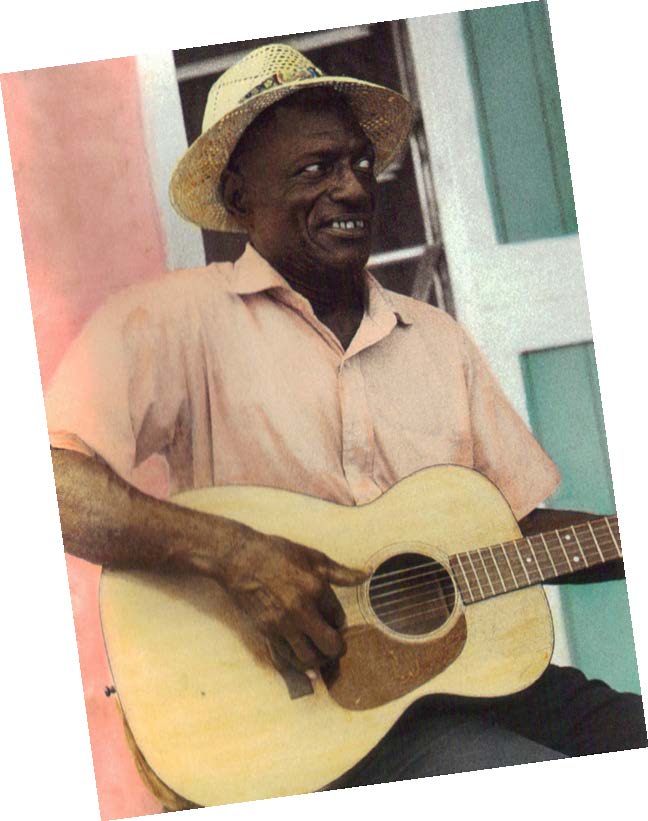
Joseph Spence
is a Bahamian
irony. Hardly
appreciated
or known in
The Bahamas
while he was
alive, his music
is credited with influencing
mega international stars who
continue to pay homage and
respect to his guitar wizardry
and his authentic voice.
Iconic groups like Tahj
Mahal, The Grateful Dead
kneel at the altar of Joseph
Spence’s guitar and he is
likened to the “folk guitarist
Thelonius Monk.
Spence’s vocalizations,
humming improvised over
his Calypso, Blues, Folk Music
and Sacred Song have
been consistent subjects of
major articles in international
magazines like Rolling
Stone, Esquire and New
York Times.
He played a steel string
acoustic guitar in what is
known as Drop D tuning.
Reviewers write that “the
power of his playing derived
from moving Bass lines and
interior voices and a driving
beat that he employed with
foot tapping. To this mix he
added the Blues, colouration,
calypso rhythms to achieve a
unique and easily identifiable
sound”.
Spence’s mastery of the guitar
and his unique way of playing
brought international
music
scholars
to his
door, who
thought
his work
was that of
two players.
Even today
he is still
featured in
international
magazines
and regarded
as guitar wizard,
an instrument
he taught
himself how to
play.
He hailed from Andros and
was the son of a pastor, and
got his start in music as a
teenager playing in his great
uncle Tony Spence’s band. After
leaving school he worked
as a sponge fisher, stonemason
and carpenter and as
a crop cutter in the United
States. The earliest recordings
of Joseph Spence were made
on Spence’s porch by folk
musicologist Samuel Charters
in 1958, with Charters initially
thinking that Spence’s guitar
playing was
the work of two
players dueling.
These were
released by
Folkways
Records on
the album
Music of the
Bahamas
Volume
One in
1959. In
1964, Fritz
Richmond
recorded
Spence,
and
recordings
made in Spence’s living room
were issued on the album
Happy All the Time. The
following year, Jody Stretcher
and Peter Siegel made the trip
to record Spence, recording
tracks also featuring Edith
and Raymond Pinder and
their daughter Geneva, which
were released on The Real
Bahamas Volume One. These
tracks included Spence’s arrangement
of “I Bid You Good
Night” which was covered by
The Grateful Dead and Ralph
McTell among others.
From the age of 16, Spence
was a sponge fisherman.
During the Second World
War he and his wife, Louise,
worked as migrant farmers on
“the contract”, where he was
influenced by a variety American
Folk traditions.
Back in Nassau he worked
in construction by day and
performed at hotels and on
yachts at night. Following a
heart attack in the mid-1970s
Spence settled into a sedate
life as a school night watchman,
although he made a
few more recordings for the
roots-oriented Arhoolie label.
His gruff voice acted as an
accompaniment to his spectacular
guitar picking, and he
was sometimes joined by his
wife Louise.
He died in relative obscurity in
Nassau on March 18, 1984.
Joseph Spence
Entertainer